A living geometry
Far from the often austere image associated with an art rooted in geometry and mathematics, Ines Silva’s Plexiglas works stand out for their airy, luminous, and profoundly musical character. Reliefs, columns, folding screens, and suspended structures create a universe in which transparency, movement, and color transform geometry into a sensory experience. Conceived with the aim of inhabiting a space with rhythm and dynamism, these works are open, visual propositions that actively engage the viewer, inviting them to move around and, at times, even intervene at the heart of their creative process.
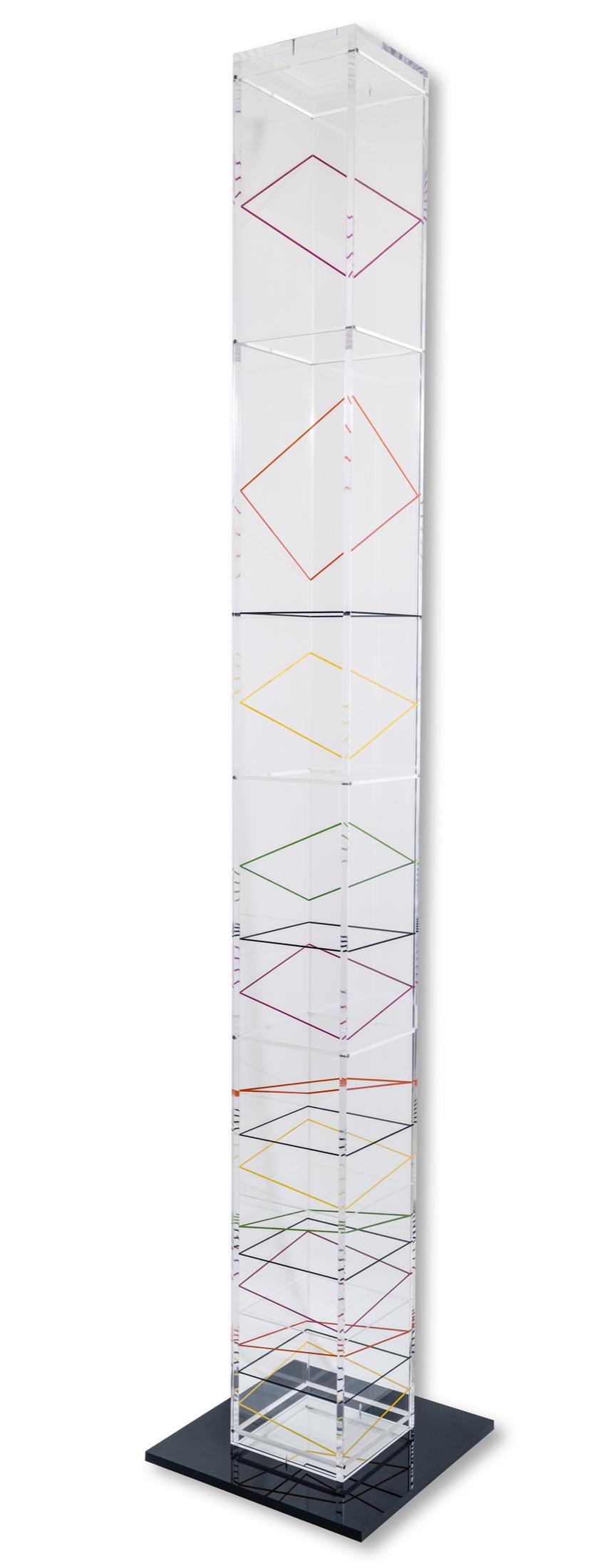 Torre PFNATrained as an architect, Ines Silva constructs each of her works with great precision, drawing on mathematical schemes in which the golden ratio, the Fibonacci spiral, and Le Corbusier’s Modulor play a structuring role. Far from serving as a theoretical demonstration, these principles ensure a balance of form and establish a perceptible harmony between the work, its surrounding space, and the viewer’s body. The tall columns, some reaching a height of 2.26 m / 7 ft 5 in (Torre PFNA), echo the Modulor directly — the system of proportions developed by Le Corbusier from the human body. Heir to Vitruvius’s reflections on the relationship between architecture and proportion, the Modulor lends Silva’s works an architectural presence that engages naturally with their surroundings.
 Ellipses ProNBEAWhile her constructive rigor remains constant, Ines Silva’s plastic vocabulary is in continual evolution. For several years now, she has shown a predilection for the ellipse, which, combined with proportions of the golden ratio, has become the generating principle of the artist’s reliefs, composed of superimposed, mobile planes (Ellipses ProNBEA). Transgressed by a few fine colored lines, Silva’s ellipses produce — depending on their orientation — effects of continuity or displacement, of interpenetration or rupture, highlighted by the contrasting use of white, blue, and black. The lines trace trajectories that animate the entire composition, passing from one plane to another and at times seeming to extend beyond the work itself. Despite this permanent mobility, the unity of the whole is never broken, so thoroughly does the underlying geometry establish a strong relationship between each element.
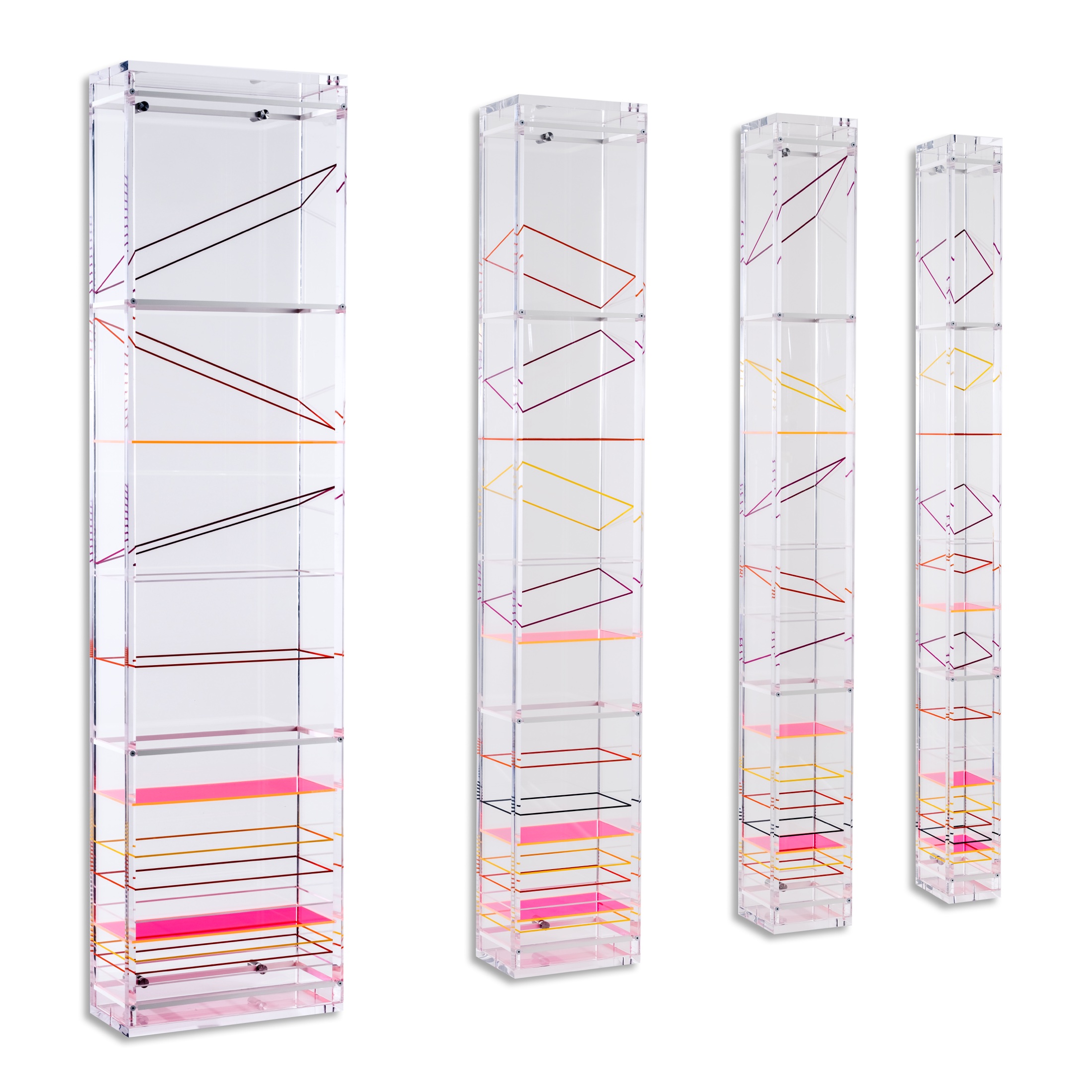 Progression 4FNA
 Tetraptych SpectrumSeveral of the artist’s series follow a principle of progression; conceived as proper visual crescendos, they present forms that gradually expand, accompanied by an intensification in the rhythmic deployment of the lines and colored planes (Progression 4FNA). The compositions alternate between vertical and horizontal readings, with interplays of obliques and counterpoint effects. Some works favor monochrome harmonies, with deep blues and intense pinks. But as a general rule, color — deliberately limited by Ines Silva to seven tones — intervenes minimally. Reduced most often to a mere thread, it discreetly guides the eye before mingling, in the course of the viewer’s movements or manipulations, with the other colored lines of the composition. The Tetraptych Spectrum series, however, produces intense chromatic vibrations that renew and intensify according to our movements.
 Column TNAB
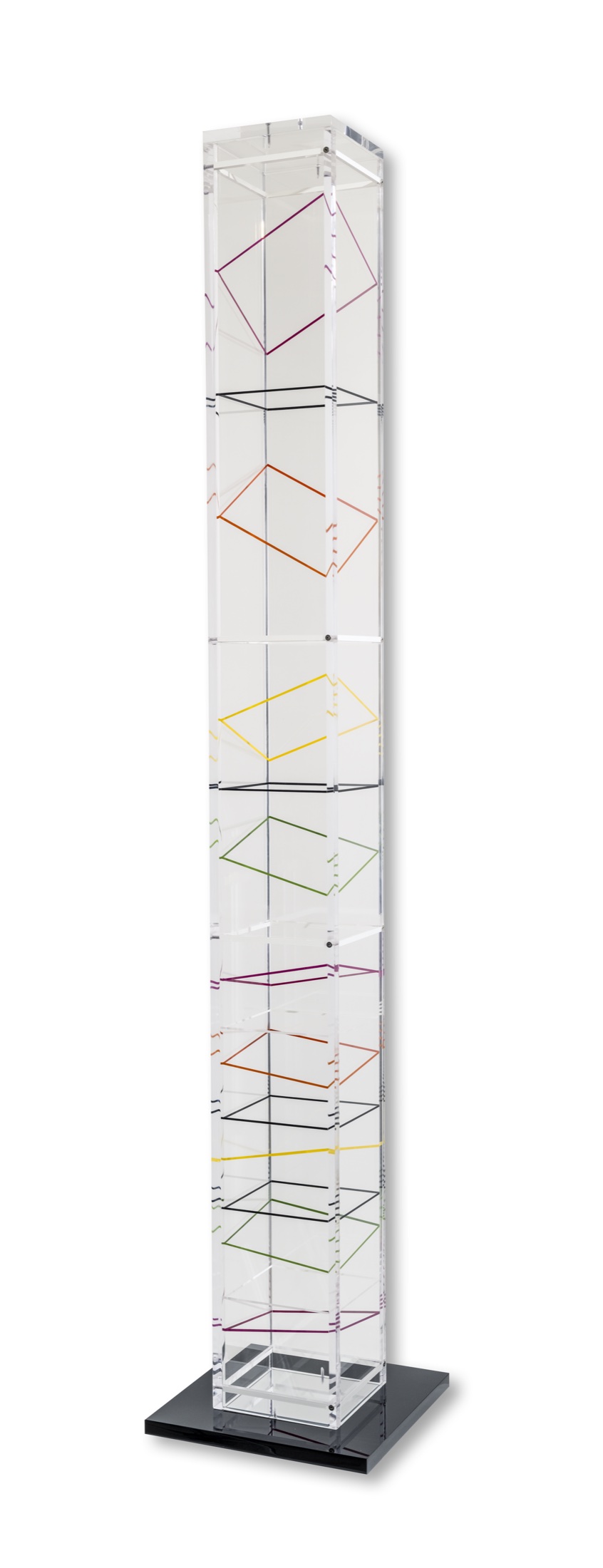 Torre P2FN
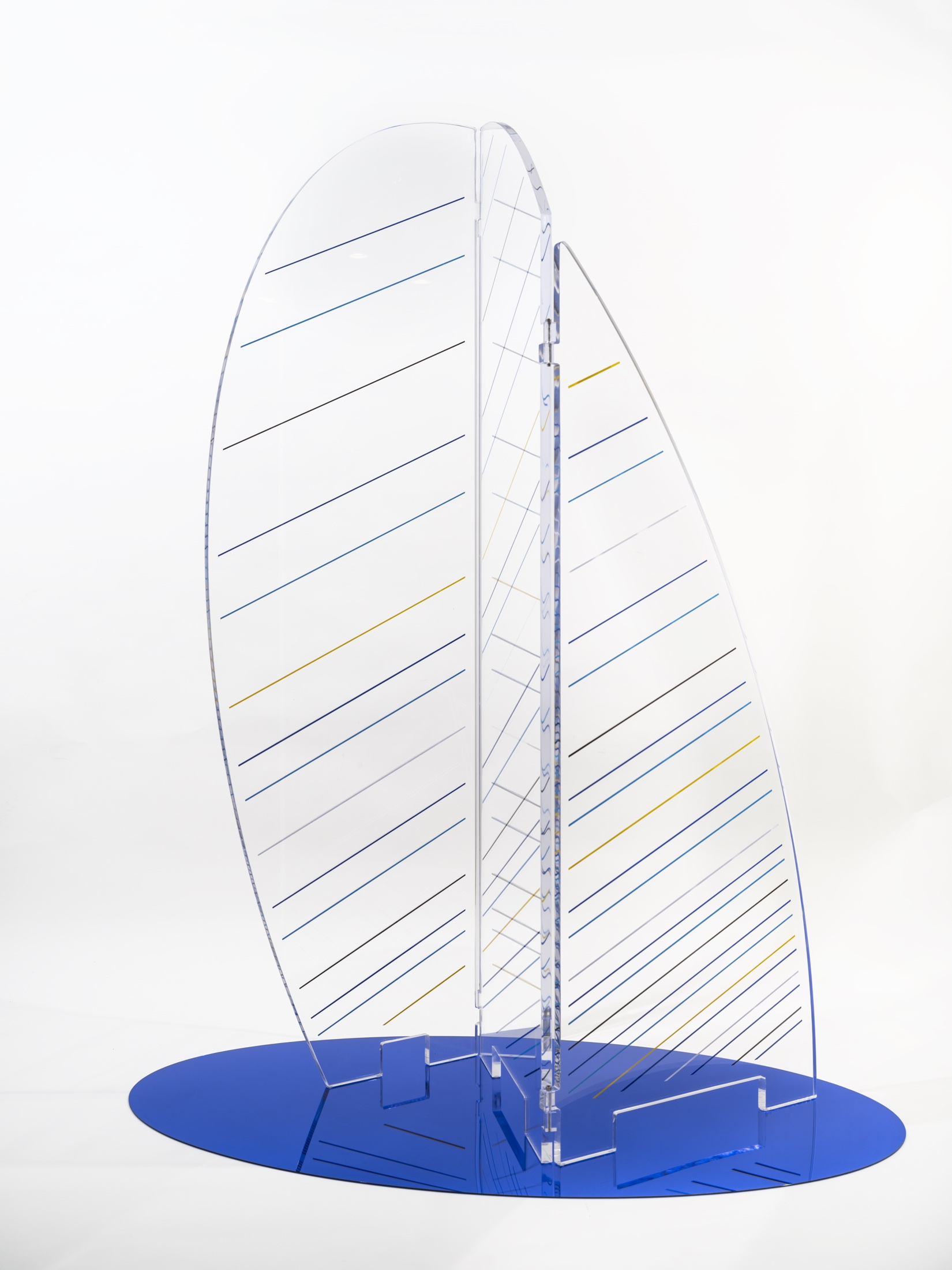 Desplegable Ellipse ProNACA
 Jardín Colgante NE
 Spiral QuadrataThe artist’s preference for the constructive form of the column reveals a desire to deploy her work at an architectural scale. The verticality of works such as Column TNAB and Torre P2FN, poised on the frontier between architecture and sculpture, reveals — as they rotate or as we move — configurations that are forever renewed. The folding screens, with their curved cut-outs (Desplegable Ellipse ProNACA), extend this reflection, while the suspended works, likewise rounded in form, float more freely in space (Jardín Colgante NE). As for the works of the Spiral Quadrata series, adorned with small mirroring surfaces, they fleetingly return the visitor’s image, integrating the viewer into the perceptual process. Ines Silva’s works never give themselves up at a single glance; each emerges in space and in time, to the rhythm of movement and interaction. The use of open forms and of transparent elements introduces a continuum between the inside and the outside of her works, between the perceived and the lived.
 Harmonic SpectrumInes Silva’s recourse to Plexiglas represents a key part of this endeavor. Its transparency allows the planes to interpenetrate, making the void itself a material in its own right. Light penetrates the works, producing colorful interferences. Regarding this point, Silva’s practice belongs to the legacy of the Constructivist experiments of Naum Gabo, Antoine Pevsner, László Moholy-Nagy, and Georges Vantongerloo, while revitalizing their reflections on the relationship between space, light, and transparency. One notes, at times, the use of metal for certain large reliefs such as Harmonic Spectrum, where small quadrilaterals of chrome- and gold-finished wire animate the broad planes, through an organization of extreme precision. Against the white ground, the cast shadows enrich the composition with a second, shifting drawing, while the reflections of the metal produce a luminous vibration that intensifies as we move. The metal elements then seem to compose a real musical score, in which rhythms, counterpoints, and silences find their plastic equivalent. This musicality is likewise found in the artist’s theoretical references — she is an avid reader of works devoted to the relationships between mathematical proportion and music, notably those of Matila Ghyka.
 Retablo ProBNFThrough the focus Ines Silva grants in her works to the notions of movement, transformation, and manipulation, the artist also embarks on a dialogue with the experiments of the geometric and kinetic avant-garde artists of the 1950s–1970s, such as those of the Madí group, but also Soto, Agam, and Lygia Clark. Like them, Silva refuses a frontal relationship to her work, in favor of an experience that is open, evolving, and forever in the making. The elliptical reliefs with their articulated panels (Retablo ProBNF), the rotating or suspended structures, all offer the viewer an infinity of possible configurations. Nothing is fixed. Every manipulation gives new life to the relationships between lines, forms, and colors, inciting ceaseless geometric combinations.
By reconciling constructive rigor with sensory experience, Ines Silva makes geometry a living language, engendering an infinity of relations. Her works, refusing to be confined within a closed system, explore the virtues of transparency in order to open themselves to the gaze and to offer an experience founded on mobility, light, and interaction. Far from an autonomous abstraction, they make perception itself the true setting of her work.