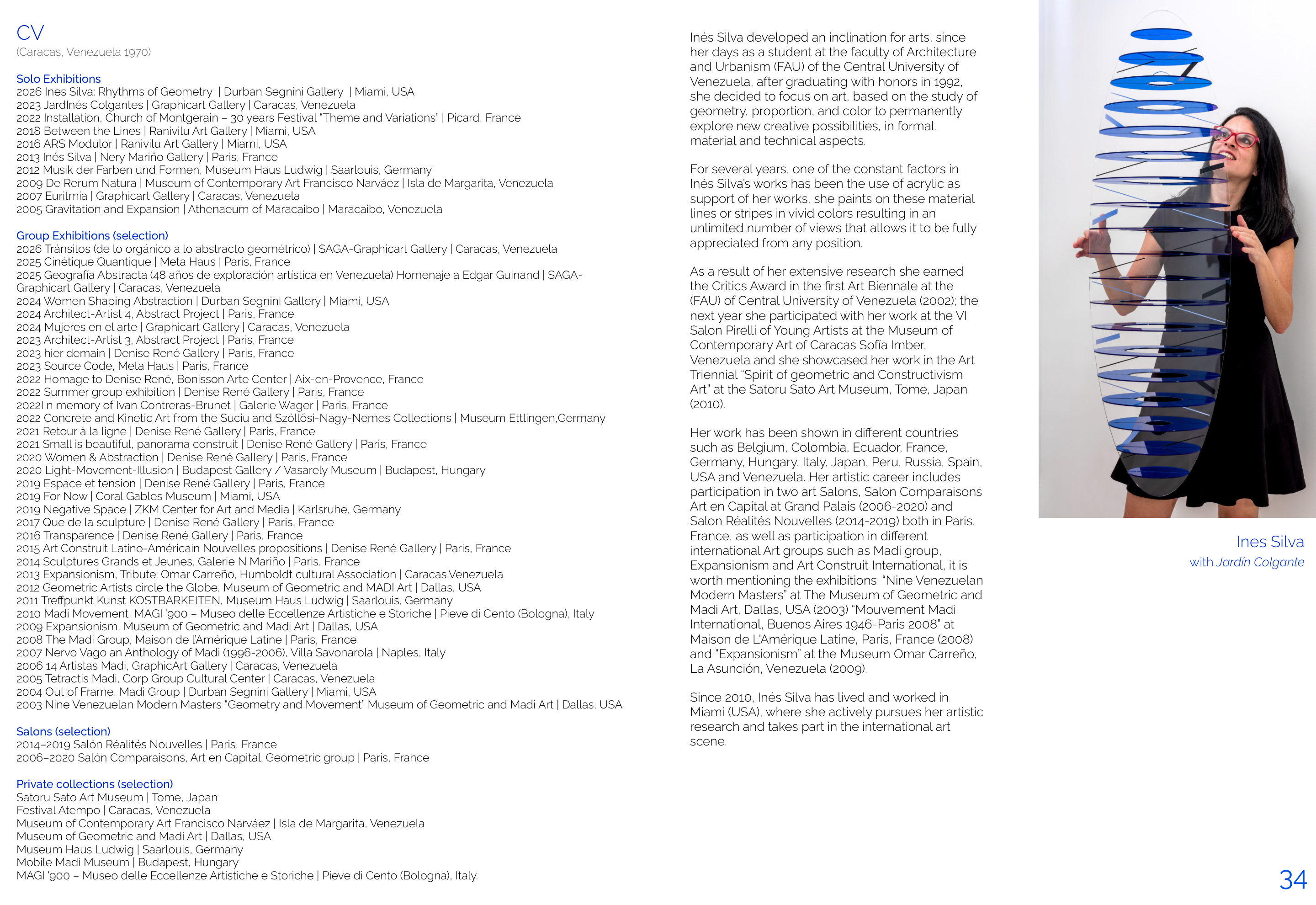
Inés Silva developed an inclination for arts, since her days as a student at the faculty of Architecture and Urbanism (FAU) of the Central University of Venezuela, after graduating with honors in 1992, she decided to focus on art, based on the study of geometry, proportion, and color to permanently explore new creative possibilities, in formal, material and technical aspects.
For several years, one of the constant factors in Inés Silva’s works has been the use of acrylic as support of her works, she paints on these material lines or stripes in vivid colors resulting in an unlimited number of views that allows it to be fully appreciated from any position.
As a result of her extensive research she earned the Critics Award in the first Art Biennale at the (FAU) of Central University of Venezuela (2002); the next year she participated with her work at the VI Salon Pirelli of Young Artists at the Museum of Contemporary Art of Caracas Sofía Imber, Venezuela and she showcased her work in the Art Triennial “Spirit of geometric and Constructivism Art” at the Satoru Sato Art Museum, Tome, Japan (2010).
Her work has been shown in different countries such as Belgium, Colombia, Ecuador, France, Germany, Hungary, Italy, Japan, Peru, Russia, Spain, USA and Venezuela. Her artistic career includes participation in two art Salons, Salon Comparaisons Art en Capital at Grand Palais (2006-2020) and Salon Réalités Nouvelles (2014-2019) both in Paris, France, as well as participation in different international Art groups such as Madi group, Expansionism and Art Construit International, it is worth mentioning the exhibitions: “Nine Venezuelan Modern Masters” at The Museum of Geometric and Madi Art, Dallas, USA (2003) “Mouvement Madi International, Buenos Aires 1946-Paris 2008” at Maison de L'Amérique Latine, Paris, France (2008) and “Expansionism” at the Museum Omar Carreño, La Asunción, Venezuela (2009).
During her career, it is worth highlighting the Solo exhibitions such as: “Gravitación y Expansión” at Ateneo de Maracaibo, Venezuela (2005), “Euritmia” at Graphic Art Gallery, Caracas, Venezuela (2007), “De Rerum Natura” at The Museum of Contemporary Art Francisco Narváez, Isla de Margarita, Venezuela (2009), “Musik der Farben und Formen” at Museum Haus Ludwig, Saarlouis, Germany (2012), “Inés Silva” at Galerie Nery Mariño, París, Francia (2013) “Ars Modulor” at Ranivilu Art Gallery, Miami, USA (2016) and “Between the Lines” at Ranivilu Art Gallery, Miami, USA (2018), Installation, Church of Montgerain - 30 years Festival Theme and Variations-. Picard, France (2022).
Since December 2015 Inés Silva is represented by the renowned Galerie Denise René in Paris, where she has participated in some collective exhibitions and projects such as: “art construit latino-americaine nouvelles propositions” at the iconic space of Galerie Denise René rive gauche (2015), “transparence” (2017) “Que de la sculpture” (2018), “Espace et Tension” (2019), women & abstraction (2020), “small is beautiful, dynamique du bleu”, retour à la ligne (2021) and Summer group exhibition (2022).
Supported by the Galerie Denise René, her work “Jardín Colgante negro” was selected for the exhibition “Negative Space” at the ZKM Center for Art and Media, Karlsruhe, Germany (2019), her work “Spectrum” was selected to the exhibition “For Now” at the Coral Gables Museum in Miami, USA (2019-2020).
Her work is best described by art critic Perán Erminy:
The conception of Inés Silva’s works, that is her ‘ars poetica’ consists of designing in her work, a formal device as a group of signals, marks, lines, gaps, proportions, mobile sheets capable of organizing itself in a harmonic manner and make intelligible and sensitively emotional, the group of dynamic situations and perceptive tensions that integrate themselves or that take place in that visual event that constitutes the work and all that is displayed in accordance with or in tune with, the invisible tensions of the space around the work.
Since 2010, Inés Silva has lived and worked in Miami (USA), where she actively pursues her artistic research and takes part in the international art scene.
Más allá de la imagen, a veces austera, asociada a un arte basado en la geometría y las matemáticas, las obras en plexiglás de Inés Silva destacan por su carácter etéreo, luminoso y profundamente musical. Relieves, columnas, biombos o estructuras suspendidas componen un universo en el que la transparencia, el movimiento y el color transforman la geometría en una experiencia sensorial. Concebidas para colmar el espacio de ritmo y dinamismo, estas creaciones son propuestas visuales abiertas que interpelan activamente al espectador, invitándolo a desplazarse e incluso adentrarse en la escena de su proceso creativo.
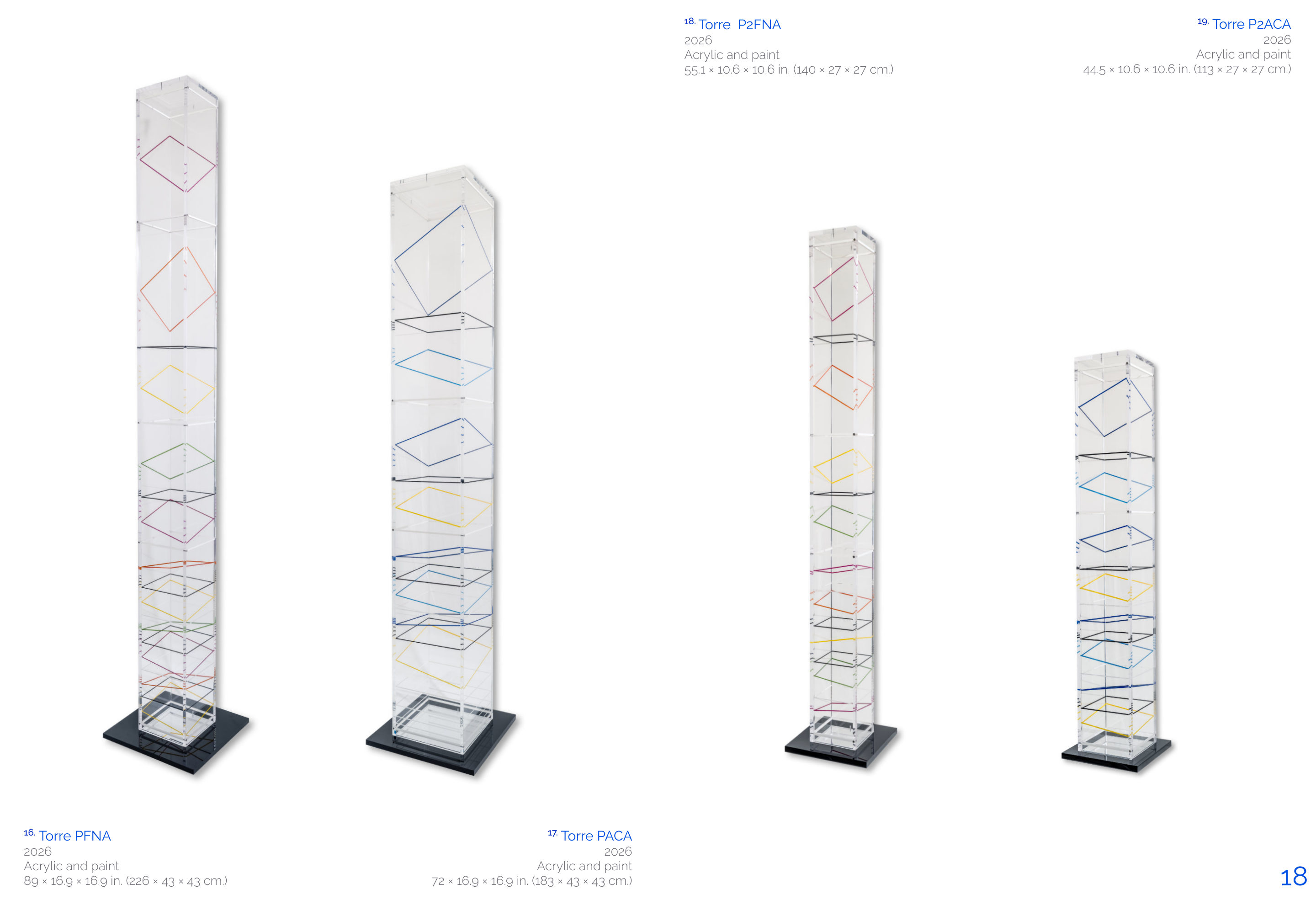
 Torre PFNAIniciada como arquitecto, Inés Silva elabora cada una de sus obras con gran precisión, a partir de esquemas matemáticos en los que la proporción áurea, la espiral de Fibonacci o el Modulor de Le Corbusier desempeñan un papel estructurante. Lejos de constituir una demostración teórica, estos principios garantizan el equilibrio de las formas y establecen una armonía perceptible entre la obra, el espacio y el cuerpo. Las grandes columnas, algunas de las cuales alcanzan los 2,26 metros de altura (Torre PFNA), se inspiran directamente en el Modulor, un sistema de proporciones elaborado por Le Corbusier a partir del cuerpo humano. Heredero de las reflexiones de Vitruvio sobre las relaciones entre la arquitectura y las proporciones, este modelo confiere a las obras una presencia arquitectónica que dialoga de forma natural con su entorno.
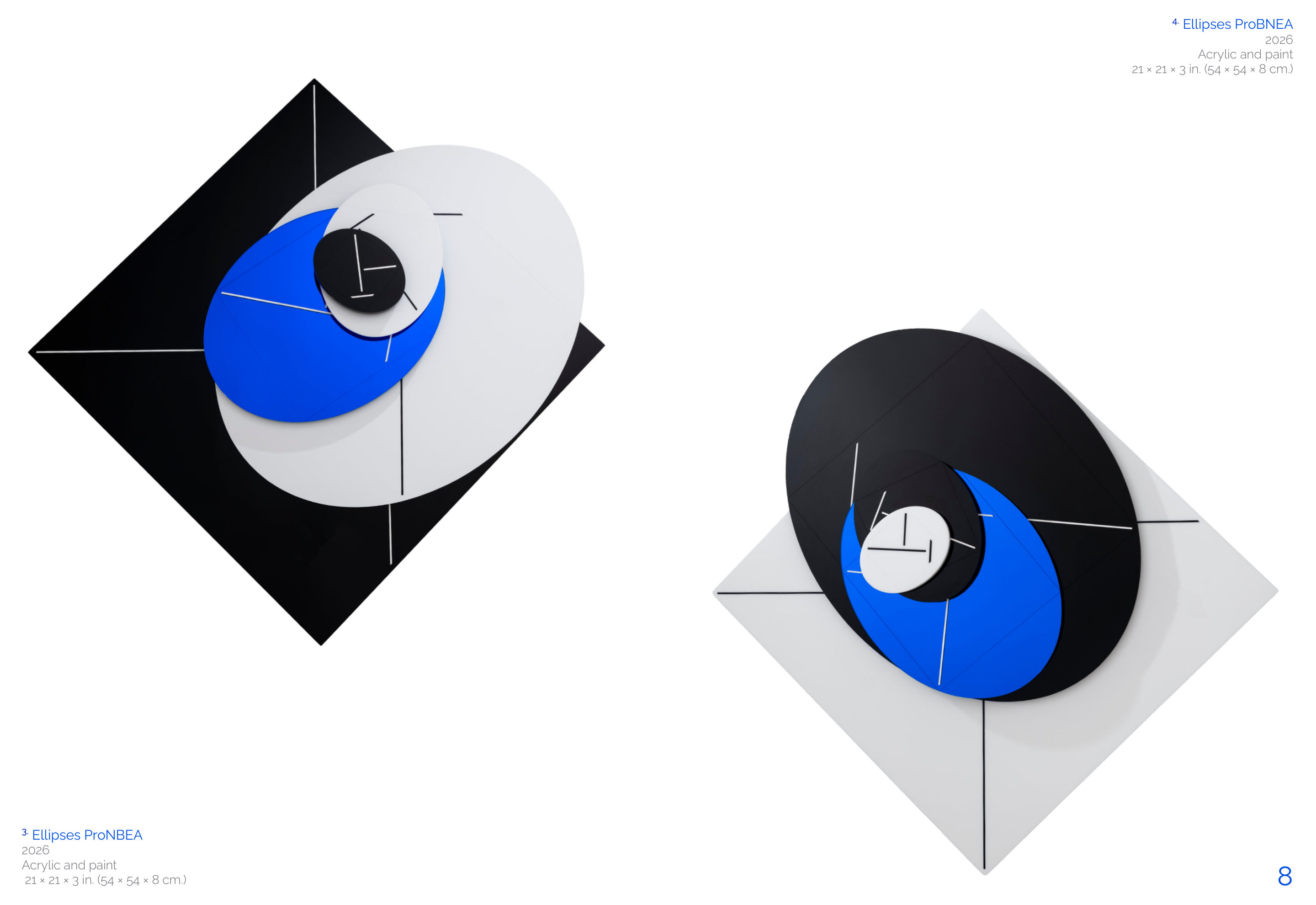
 Ellipses ProNBEASi bien el rigor constructivo se mantiene constante, el vocabulario plástico de Inés Silva no deja de evolucionar. Desde hace varios años, la artista muestra una predilección por la elipse que, asociada a las proporciones de la proporción áurea, se convierte en el principio generador de relieves compuestos por planos superpuestos y móviles (Ellipses ProNBEA). Atravesados por unas finas líneas de color, estos relieves producen, según su orientación, efectos de continuidad o desfase, de interpenetración o de ruptura, resaltados por el uso contrastado del blanco, el azul y el negro. Las líneas trazan trayectorias que animan toda la composición, pasan de un plano a otro y parecen prolongarse a veces más allá de la obra. A pesar de esta movilidad permanente, la unidad del conjunto nunca se rompe, ya que la geometría subyacente organiza las relaciones entre cada elemento.
 Progression 4FNA
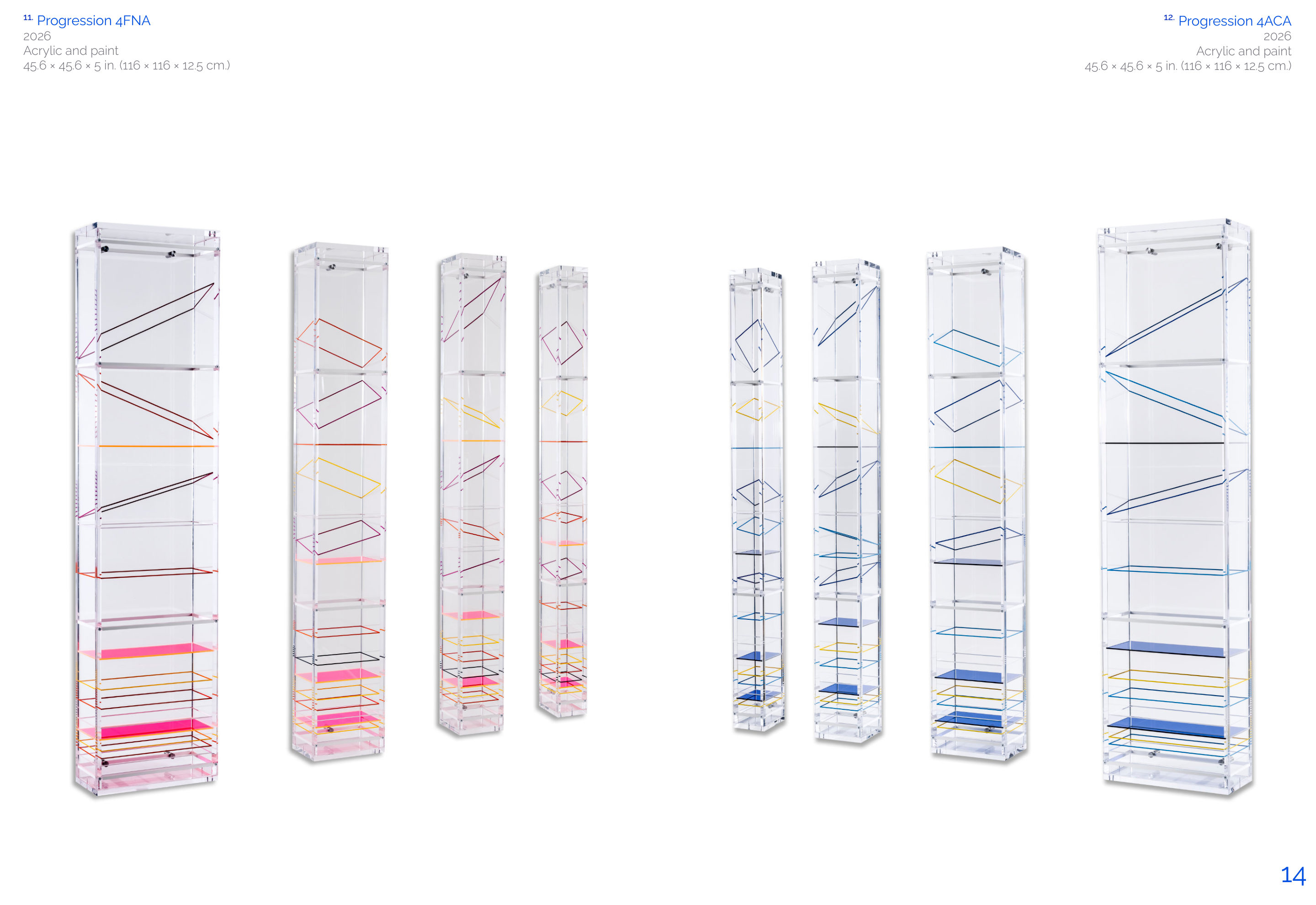
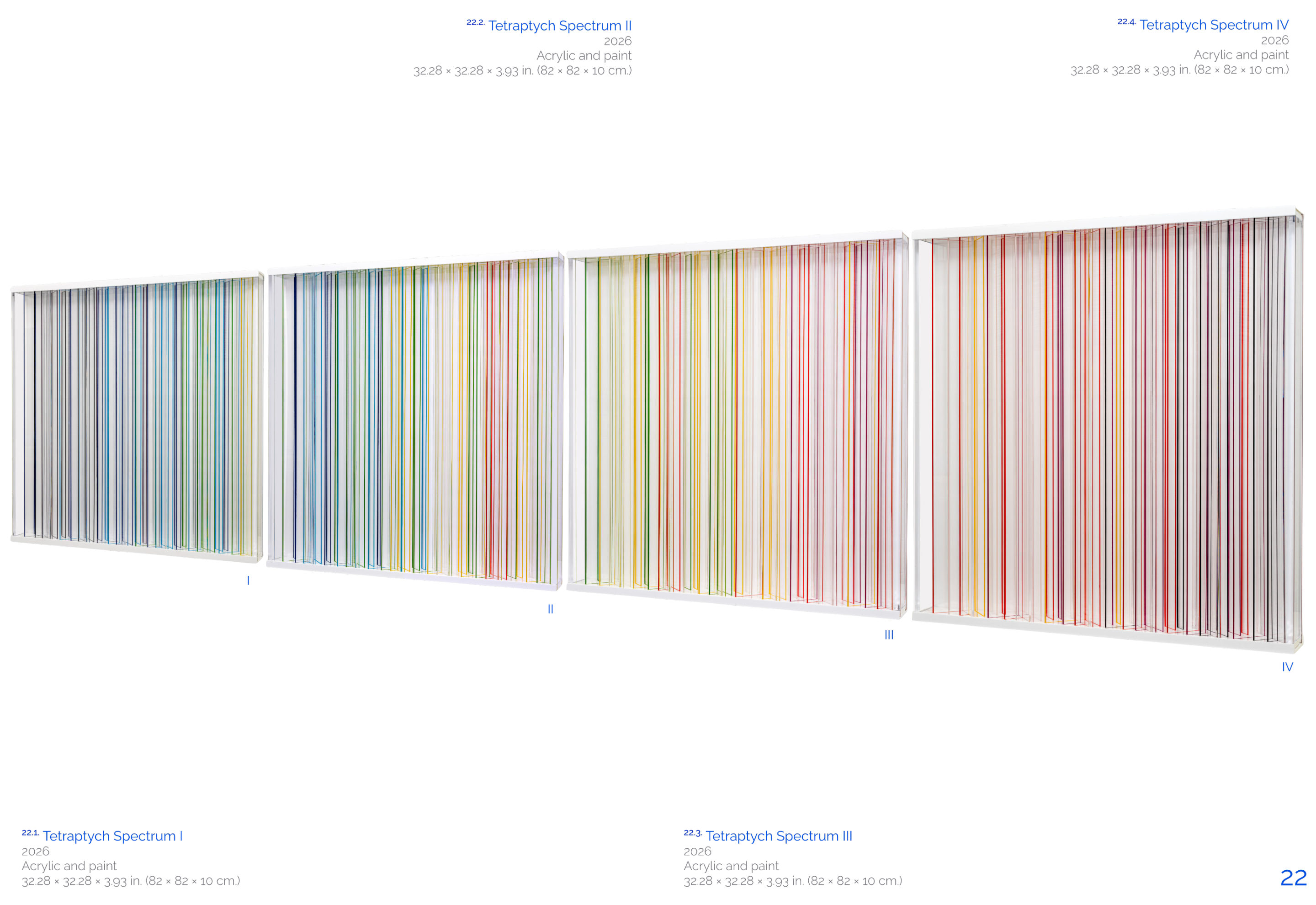
 Tetraptych SpectrumVarias series responden al principio de progresión: concebidas como auténticos crescendos visuales, presentan formas que se agrandan progresivamente, acompañadas de una intensificación en el despliegue rítmico de las líneas y los planos de color (Progression 4FNA). Las composiciones alternan lecturas verticales y horizontales, con juegos de líneas oblicuas y efectos contrapuntísticos. Algunas obras privilegian las armonías monocromáticas, con azules profundos y rosas intensos. Pero, en general, el color —deliberadamente limitado a siete tonos por Inés Silva— interviene de forma mínima. Reducido en la mayoría de los casos a un simple trazo, guía discretamente la mirada antes de entremezclarse, según los desplazamientos o las manipulaciones, con las demás líneas de color de la composición. Sin embargo, la serie Tetraptych Spectrum produce intensas vibraciones cromáticas que se renuevan y se intensifican en función de nuestros movimientos.
 Column TNAB
 Torre P2FN
 Desplegable Ellipse ProNACA
 Jardín Colgante NE
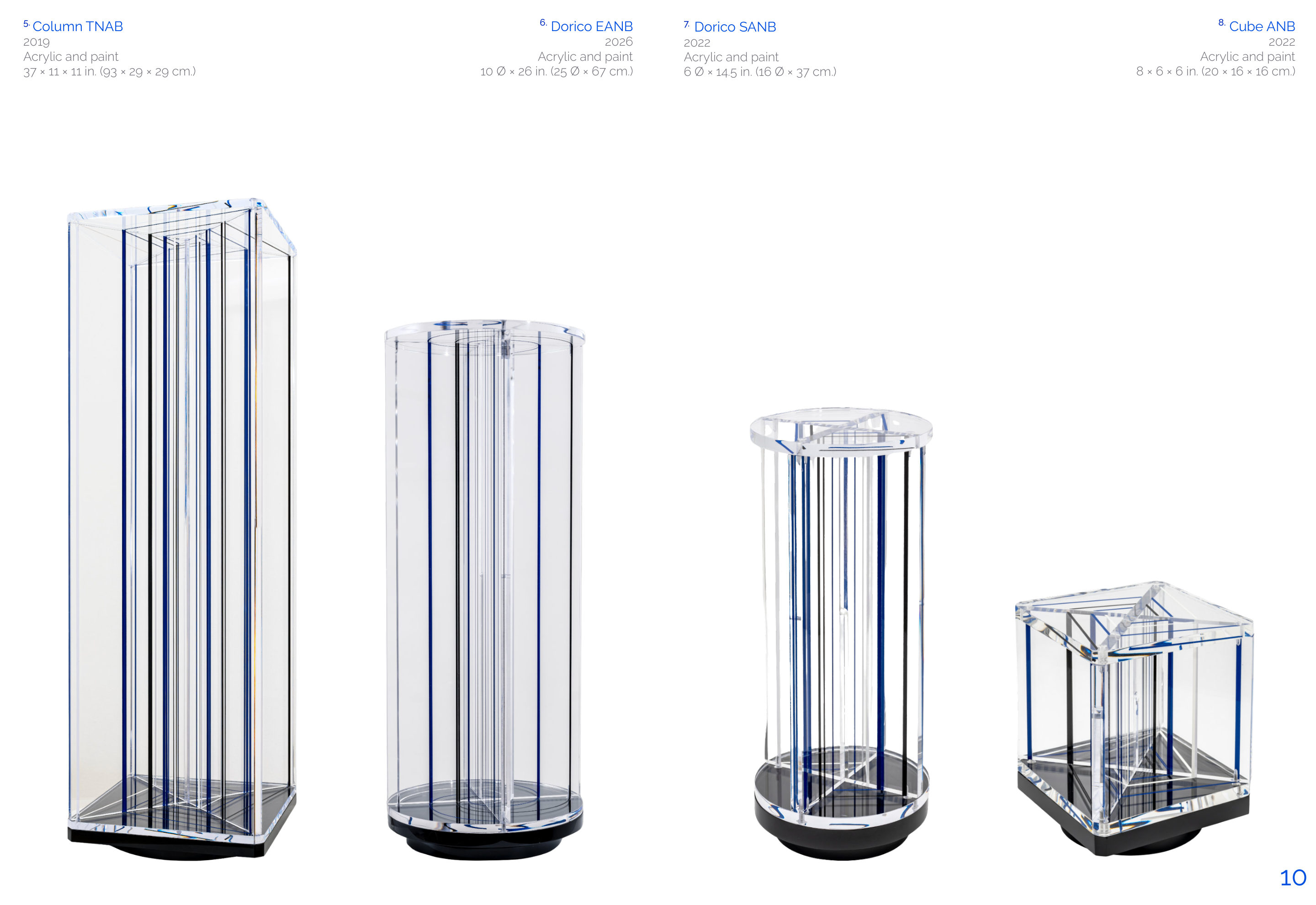
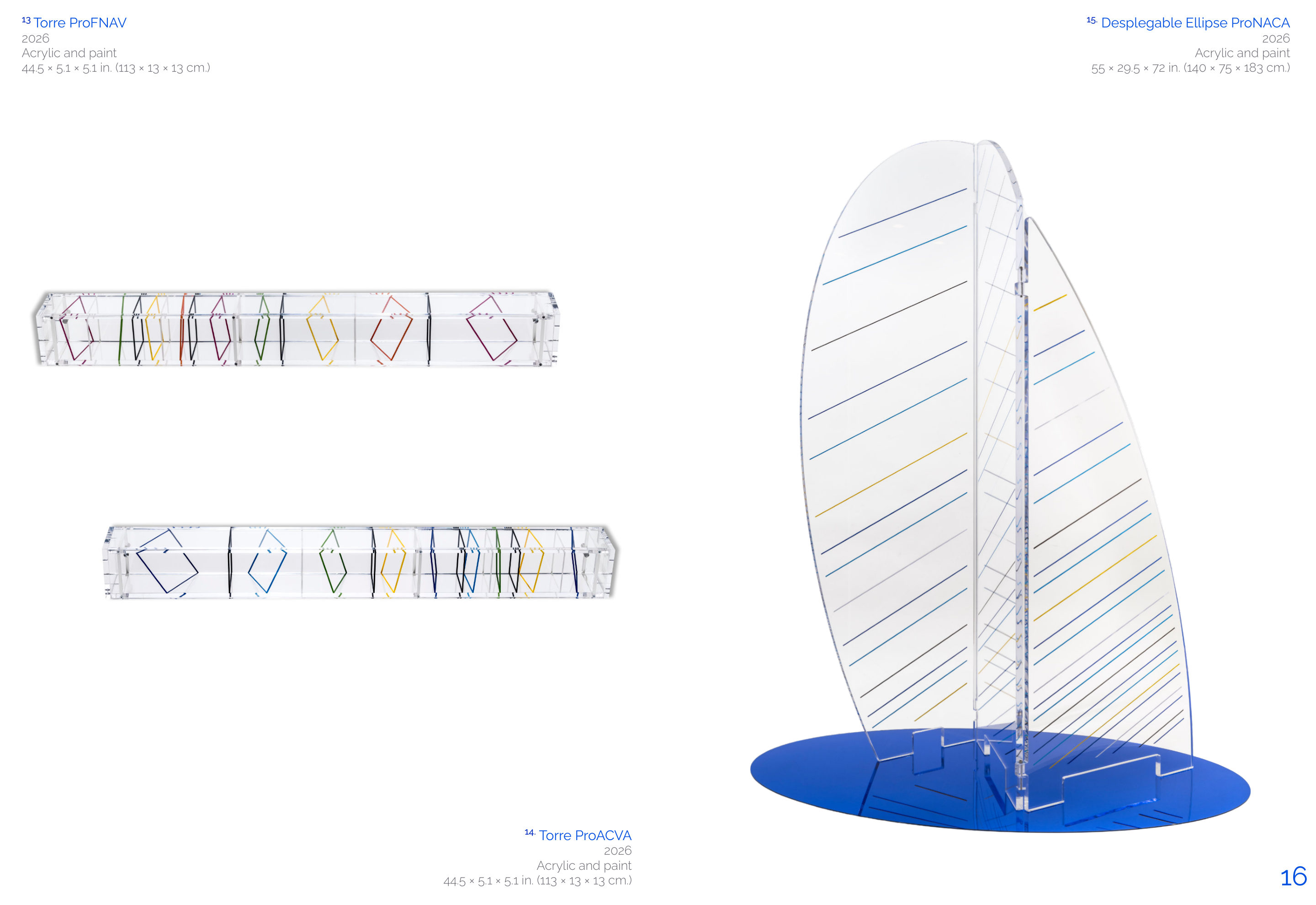
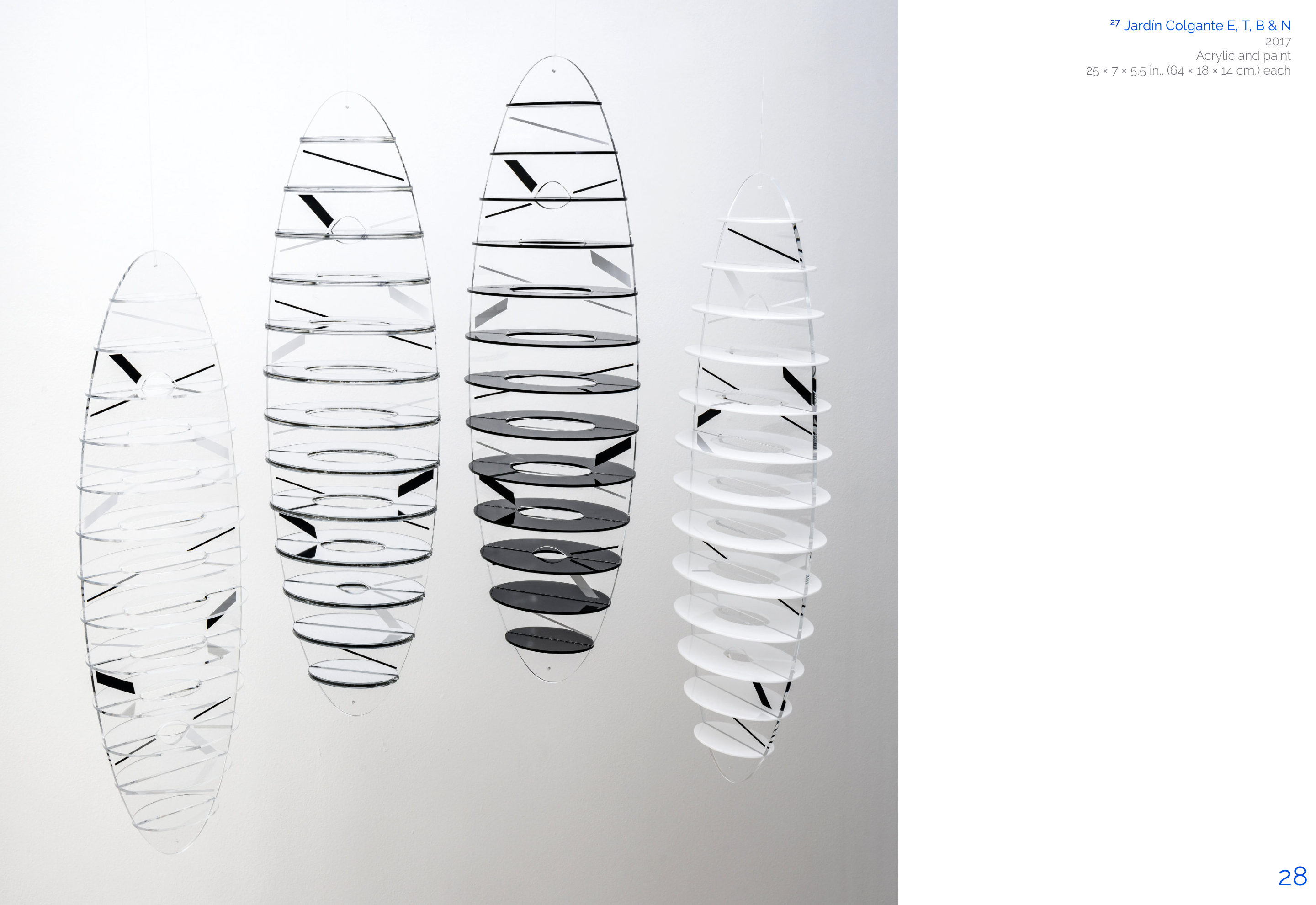
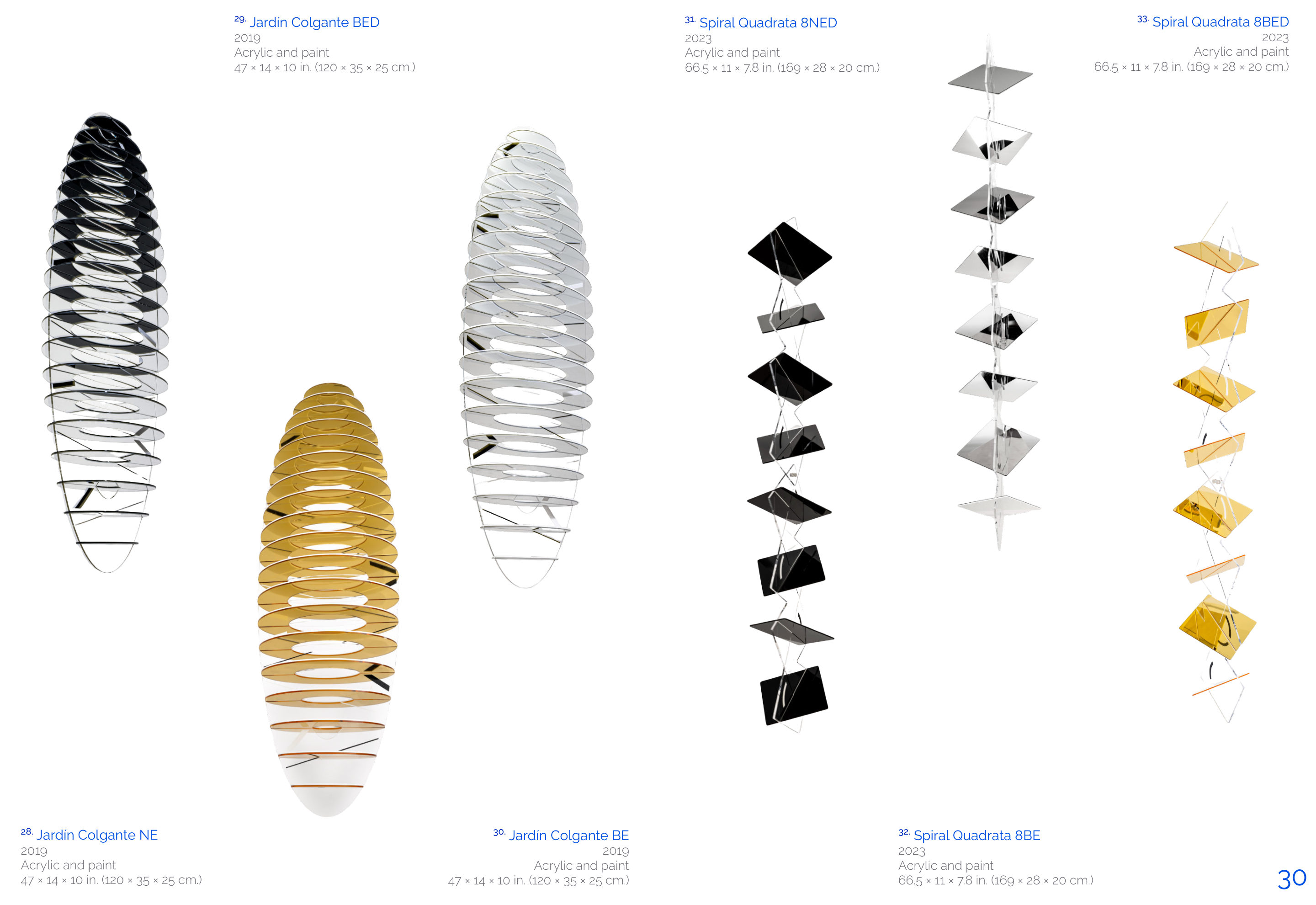
 Spiral QuadrataLa predilección de la artista por la forma constructiva de la columna delata el deseo de desplegar su obra a escala arquitectónica. La verticalidad de obras como Column TNAB y Torre P2FN, en la frontera entre la arquitectura y la escultura, despliega, al ritmo de su rotación o de nuestros movimientos, configuraciones siempre renovadas. Los biombos, con recortes curvos (Desplegable Ellipse ProNACA), prolongan esta reflexión, mientras que las obras suspendidas, de formas igualmente redondeadas, flotan con mayor libertad en el espacio (Jardín Colgante NE). En cuanto a las obras de la serie Spiral Quadrata, adornadas con pequeñas superficies espejadas, reflejan fugazmente la imagen del visitante, integrándolo así en el proceso perceptivo. Las creaciones de Inés Silva nunca se revelan de un solo vistazo, sino que se construyen en el espacio y en el tiempo, al ritmo de los desplazamientos y las interacciones. El empleo de formas abiertas y el uso de la transparencia introducen un continuo entre el interior y el exterior, lo percibido y lo vivido.
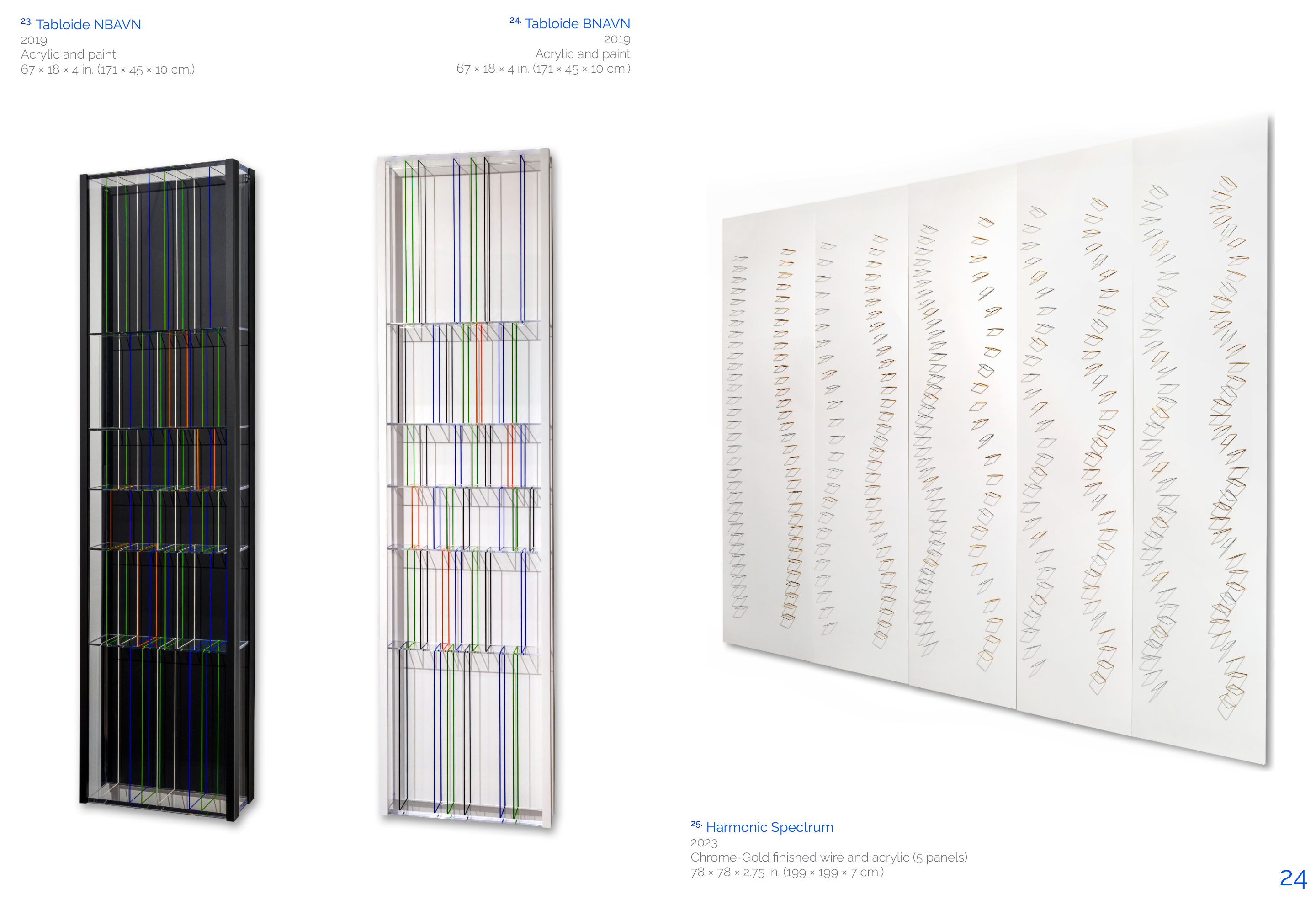
 Harmonic SpectrumEl recurso de Inés Silva al plexiglás forma parte integrante de esta investigación. Gracias a su transparencia, permite que los planos se interpenetren, convirtiendo el vacío en un material por derecho propio. La luz atraviesa las obras y produce interferencias de color. En este sentido, la obra de Inés Silva se inscribe en la alquimia de las indagaciones constructivistas de Naum Gabo, Antoine Pevsner, László Moholy-Nagy o Georges Vantongerloo, al tiempo que renueva su reflexión sobre las relaciones entre el espacio, la luz y la transparencia. En ocasiones se aprecia el uso del metal en algunos grandes relieves como Harmonic Spectrum, donde pequeños cuadriláteros de alambre cromado y dorado animan los grandes planos, siguiendo una organización de extrema precisión. Sobre el fondo blanco, sus sombras proyectadas enriquecen la composición con un segundo dibujo en movimiento, mientras los reflejos del metal producen una vibración luminosa que se intensifica con nuestros desplazamientos. Los elementos metálicos parecen entonces componer una auténtica partitura musical, en la que los ritmos, los contrapuntos y los silencios encuentran su equivalente plástico. Esta musicalidad se refleja también en las referencias teóricas de la artista, apasionada por las obras dedicadas a las relaciones entre las proporciones matemáticas y la música, en particular las de Matila Ghyka.
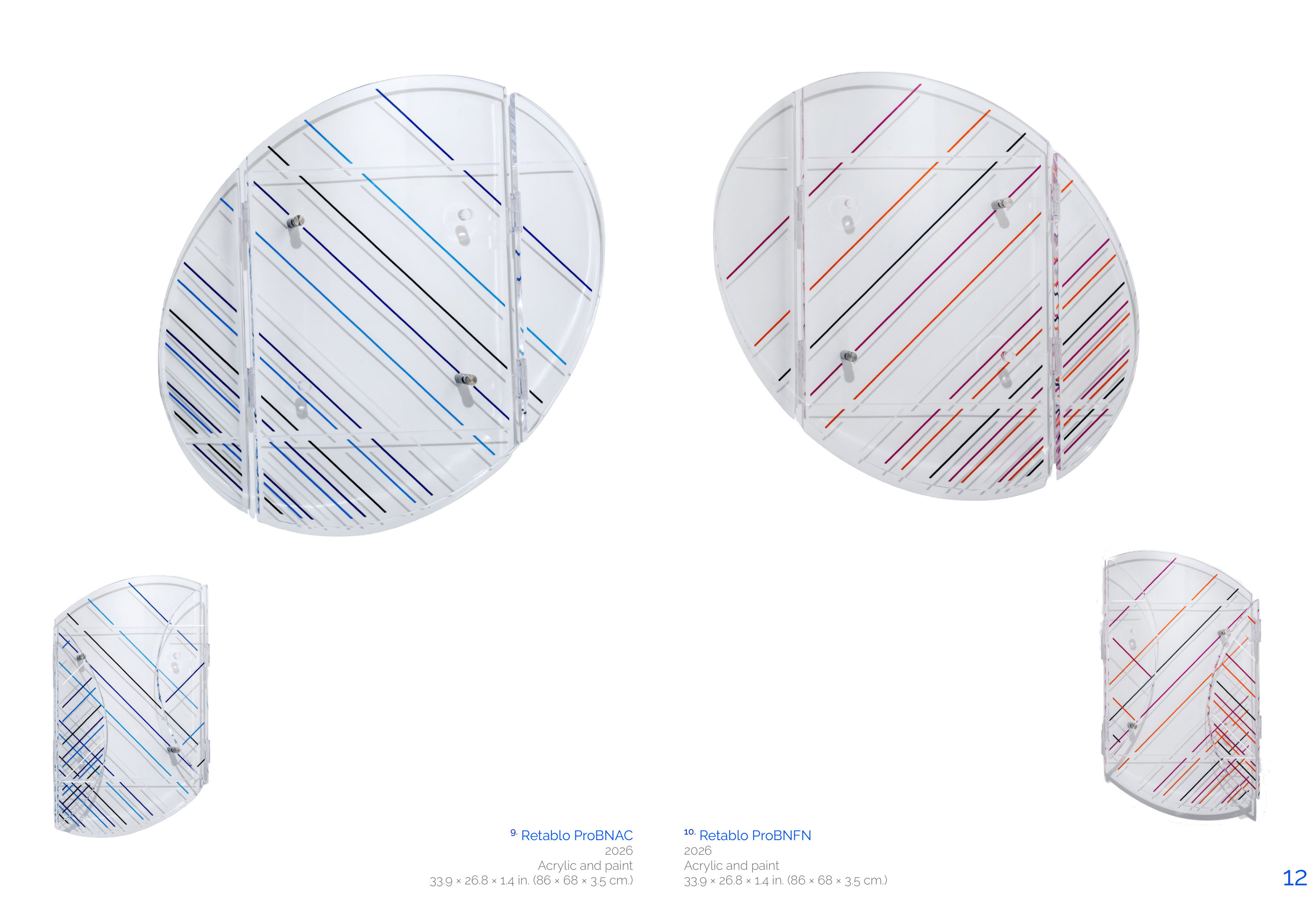
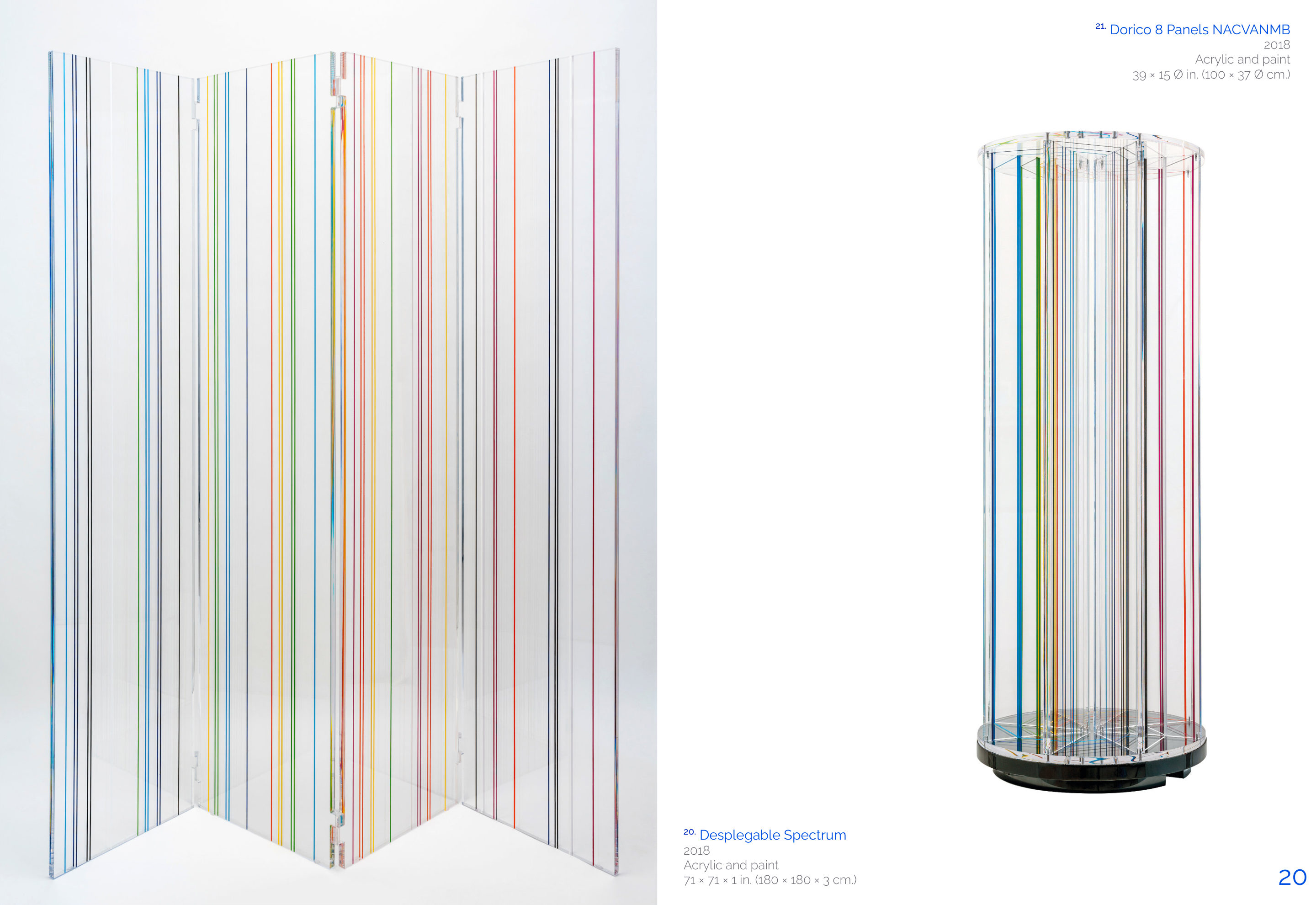
 Retablo ProBNFPor el lugar que concede en sus obras a las nociones de movimiento, transformación y manipulación, Inés Silva también dialoga con las indagaciones de los artistas de la vanguardia geométrica y cinética de los años 1950-1970, como los del grupo Madí, e igualmente Soto, Agam, Lygia Clark… Al igual que ellos, Inés Silva rechaza la relación frontal con la obra en favor de una experiencia abierta, evolutiva y siempre en devenir. Los relieves elípticos con paneles articulados (Retablo ProBNF), las estructuras giratorias o suspendidas ofrecen al espectador una infinidad de configuraciones posibles. Nada es inmutable. Cada manipulación renueva las relaciones entre las líneas, las formas y los colores, dando lugar a incesantes combinaciones geométricas.
Inés Silva, al conciliar el rigor constructivo con la experiencia sensorial, convierte la geometría en un lenguaje vivo, que genera una infinidad de relaciones. Sus obras, que se niegan a encerrarse en un sistema cerrado, exploran las virtudes de la transparencia para abrirse a la mirada y ofrecer una experiencia basada en la movilidad, la luz y la interacción. Lejos de una abstracción autónoma, hacen de la percepción en sí, el auténtico lugar de la obra.
Loin de l’image parfois austère que l’on associe à un art fondé sur la géométrie et les mathématiques, les œuvres en Plexiglas d’Ines Silva se distinguent par leur caractère aérien, lumineux et profondément musical. Reliefs, colonnes, paravents ou structures suspendues composent un univers où la transparence, le mouvement et la couleur transforment la géométrie en une expérience sensible. Conçues pour investir l’espace avec rythme et dynamisme, ces créations sont des propositions visuelles ouvertes qui sollicitent activement le spectateur, l’invitent à se déplacer, parfois même à intervenir au sein de leur processus créatif.
Torre PFNAFormée à l’architecture, Ines Silva élabore chacune de ses œuvres avec une grande précision, à partir de schémas mathématiques où le nombre d’or, la spirale de Fibonacci ou encore le Modulor de Le Corbusier jouent un rôle structurant. Loin de constituer une démonstration théorique, ces principes assurent l’équilibre des formes et instaurent une harmonie perceptible entre l’œuvre, l’espace et le corps. Les grandes colonnes, dont certaines atteignent 2,26 mètres de haut (Torre PFNA), font directement écho au Modulor, système de proportions élaboré par Le Corbusier à partir du corps humain. Héritier des réflexions de Vitruve sur les rapports entre architecture et proportions, ce modèle confère aux œuvres une présence architecturale qui dialogue naturellement avec leur environnement.
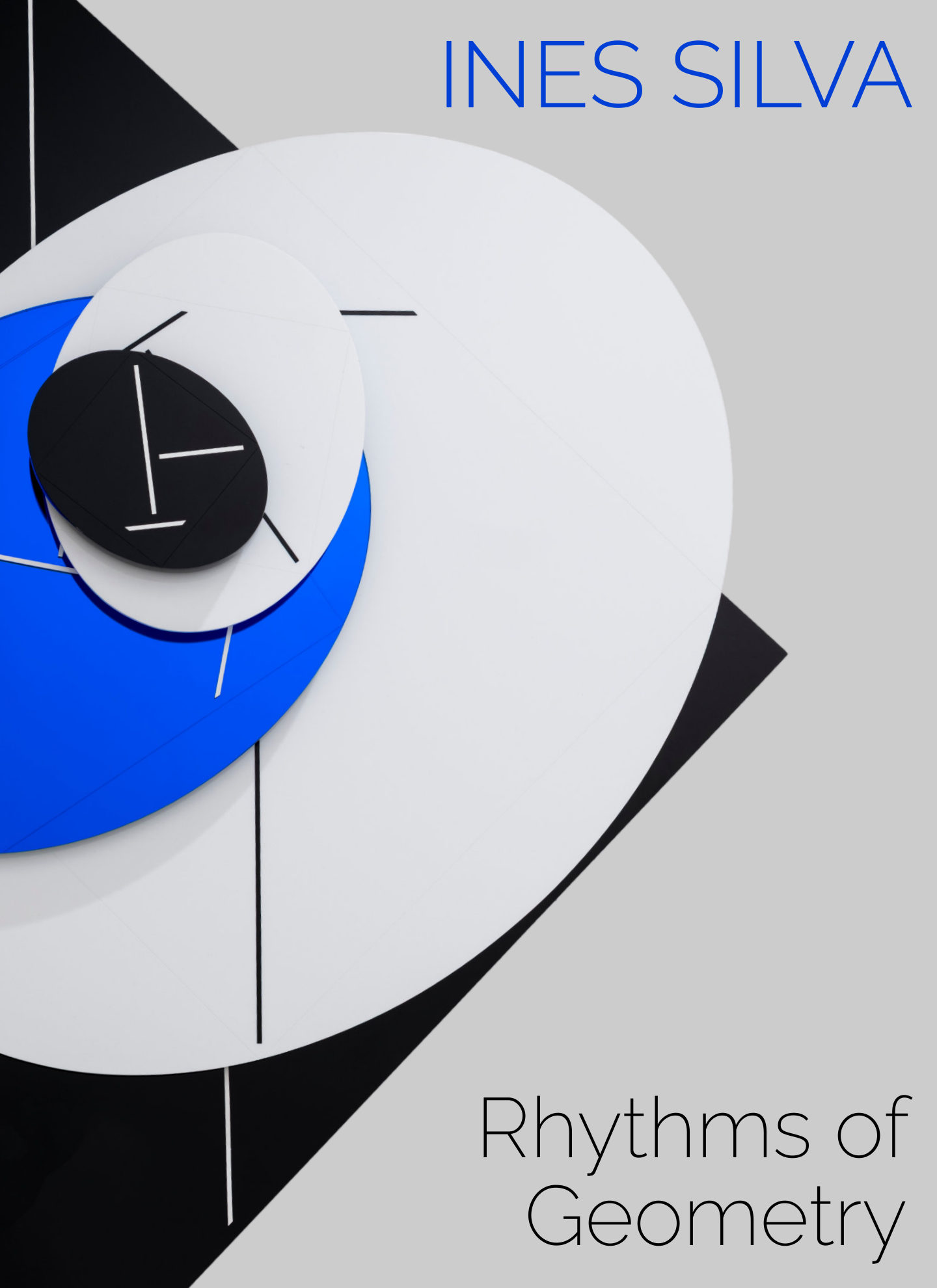
Ellipses ProNBEASi la rigueur constructive demeure constante, le vocabulaire plastique d’Ines Silva ne cesse d’évoluer. Depuis plusieurs années, l’artiste manifeste une prédilection pour l’ellipse qui, associée aux proportions du nombre d’or, devient le principe générateur de reliefs composés de plans superposés et mobiles (Ellipses ProNBEA). Traversés de quelques fines lignes colorées, ceux-ci produisent, selon leur orientation, des effets de continuité ou de décalage, d’interpénétration ou de rupture, soulignés par le recours contrasté au blanc, bleu et noir. Les lignes dessinent des trajectoires qui animent toute la composition, passent d’un plan à l’autre et semblent se prolonger parfois au-delà de l’œuvre. Malgré cette mobilité permanente, l’unité de l’ensemble n’est jamais rompue, tant la géométrie sous-jacente organise les relations entre chaque élément.
Progression 4FNATetraptych SpectrumPlusieurs séries répondent au principe de progression : conçues comme de véritables crescendo visuels, elles présentent des formes qui s’agrandissent progressivement, accompagnées d’une intensification dans le déploiement rythmique des lignes et des plans colorés (Progression 4FNA). Les compositions alternent lectures verticales et horizontales, avec des jeux d’obliques et des effets de contrepoints. Certaines œuvres privilégient des harmonies monochromes, avec des bleus profonds, des roses intenses. Mais de manière générale, la couleur, volontairement limitée à sept teintes par Ines Silva, intervient de manière minimale. Réduite le plus souvent à un simple filet, elle guide discrètement le regard avant de se mêler, au gré des déplacements ou des manipulations, aux autres lignes colorées de la composition. Toutefois, la série Tetraptych Spectrum produit des vibrations chromatiques intenses qui se renouvellent et s’intensifient en fonction de nos déplacements.
Column TNABTorre P2FNDesplegable Ellipse ProNACAJardín Colgante NESpiral QuadrataLa prédilection de l’artiste pour la forme constructive de la colonne trahit le désir de déployer son travail à l’échelle de l’architecture. La verticalité d’œuvres telles que Column TNAB et Torre P2FN, à la frontière de l’architecture et de la sculpture, déploie au gré de leur rotation ou de nos mouvements des configurations toujours renouvelées. Les paravents, aux découpes courbes (Desplegable Ellipse ProNACA), prolongent cette réflexion tandis que les œuvres suspendues, aux formes également arrondies, flottent plus librement dans l’espace (Jardín Colgante NE). Quant aux œuvres de la série Spiral Quadrata, parées de petites surfaces miroitantes, renvoient fugitivement l’image du visiteur, intégrant celui-ci au processus perceptif. Les réalisations d’Ines Silva ne se donnent jamais d’un seul regard, elle se construit dans l’espace et dans le temps, au rythme des déplacements et des interactions. L’emploi de formes ouvertes et l’utilisation de la transparence introduit un continuum entre le dedans et le dehors, le perçu et le vécu.
Harmonic SpectrumLe recours d’Ines Silva au Plexiglas participe pleinement de cette recherche. Par sa transparence, il permet aux plans de s’interpénétrer, faisant du vide un matériau à part entière. La lumière traverse les œuvres, produit des interférences colorées. En cela, le travail d’Ines Silva s’inscrit dans l’héritage des recherches constructivistes de Naum Gabo, Antoine Pevsner, László Moholy-Nagy ou de Georges Vantongerloo, tout en renouvelant leur réflexion sur les rapports entre espace, lumière et transparence. On note parfois l’emploi du métal dans certains grands reliefs comme Harmonic Spectrum, où de petits quadrilatères de fil chromé et doré animent les grands plans, selon une organisation d’une extrême précision. Sur le fond blanc, leurs ombres portées enrichissent la composition d’un second dessin mouvant, tandis que les reflets du métal produisent une vibration lumineuse qui s’intensifie au gré de nos déplacements. Les éléments métalliques semblent alors composer une véritable partition musicale, où les rythmes, les contrepoints et les silences trouvent leur équivalent plastique. Cette musicalité se retrouve également dans les références théoriques de l’artiste, férue d’ouvrages consacrés aux rapports entre proportions mathématiques et musique, notamment ceux de Matila Ghyka.
Retablo ProBNFPar la place qu’elle accorde dans ses œuvres aux notions de mouvement, de transformation et de manipulation, Ines Silva dialogue aussi avec les expérimentations des artistes de l’avant-garde géométrique et cinétique des années 1950-1970, tels que ceux du groupe Madi, mais aussi Soto, Agam, Lygia Clark… Comme eux, Ines Silva refuse le rapport frontal à l’œuvre au profit d’une expérience ouverte, évolutive et toujours en devenir. Les reliefs elliptiques et aux pans articulés (Retablo ProBNF), les structures rotatives ou suspendues offrent au spectateur une infinité de configurations possibles. Rien n’est figé. Chaque manipulation renouvelle les rapports entre les lignes, les formes et les couleurs, faisant naître d’incessantes combinaisons géométriques.
Ines Silva, en conciliant rigueur constructive et expérience sensible, fait de la géométrie un langage vivant, engendrant une infinité de relations. Ses œuvres, refusant de s’enfermer dans un système clos, explorent les vertus de la transparence pour s’ouvrir au regard et proposer une expérience fondée sur la mobilité, la lumière et l’interaction. Loin d’une abstraction autonome, elles font de la perception elle-même le véritable lieu de l’œuvre.
Far from the often austere image associated with an art rooted in geometry and mathematics, Ines Silva’s Plexiglas works stand out for their airy, luminous, and profoundly musical character. Reliefs, columns, folding screens, and suspended structures create a universe in which transparency, movement, and color transform geometry into a sensory experience. Conceived with the aim of inhabiting a space with rhythm and dynamism, these works are open, visual propositions that actively engage the viewer, inviting them to move around and, at times, even intervene at the heart of their creative process.
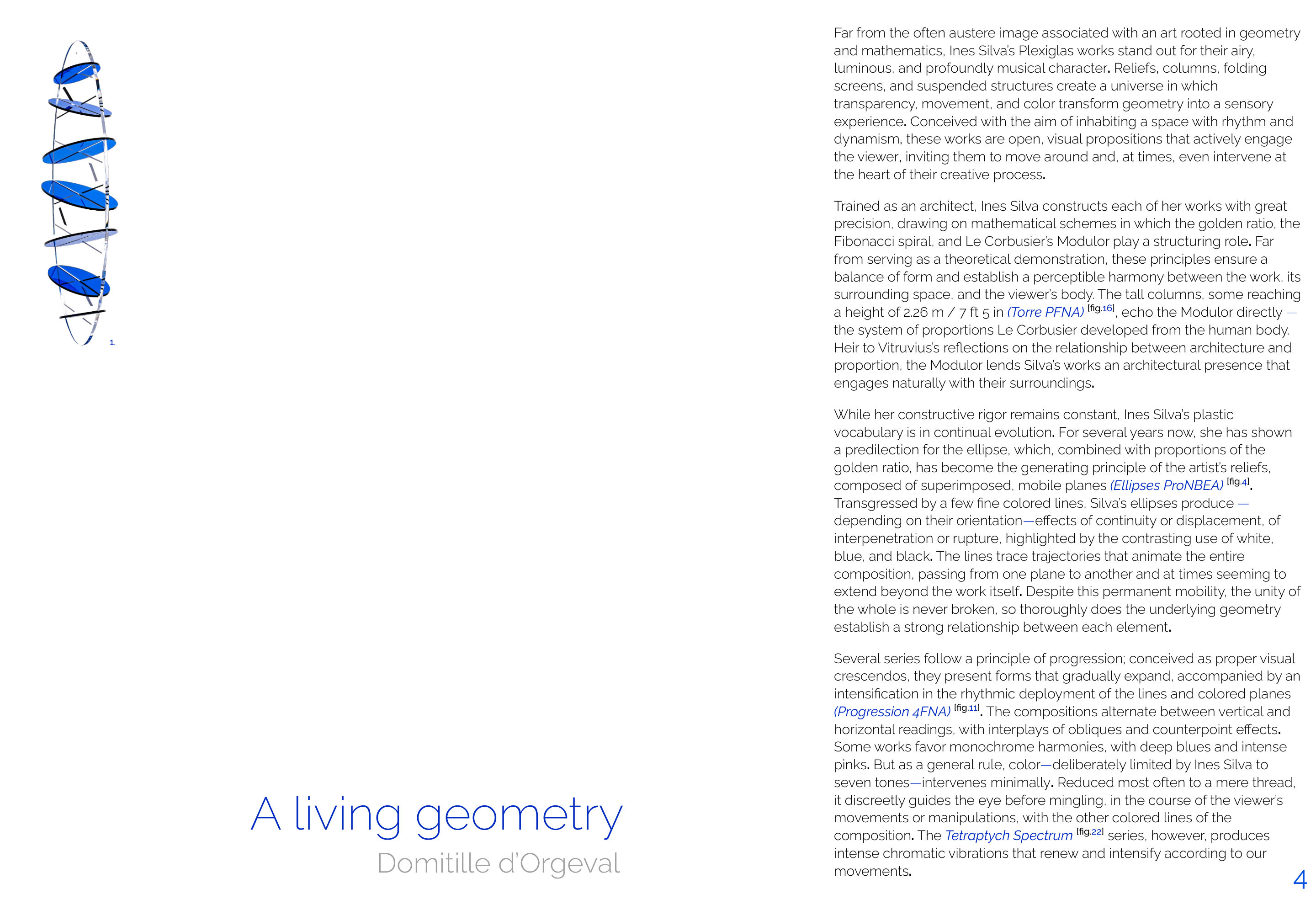
Torre PFNATrained as an architect, Ines Silva constructs each of her works with great precision, drawing on mathematical schemes in which the golden ratio, the Fibonacci spiral, and Le Corbusier’s Modulor play a structuring role. Far from serving as a theoretical demonstration, these principles ensure a balance of form and establish a perceptible harmony between the work, its surrounding space, and the viewer’s body. The tall columns, some reaching a height of 2.26 m / 7 ft 5 in (Torre PFNA), echo the Modulor directly — the system of proportions developed by Le Corbusier from the human body. Heir to Vitruvius’s reflections on the relationship between architecture and proportion, the Modulor lends Silva’s works an architectural presence that engages naturally with their surroundings.
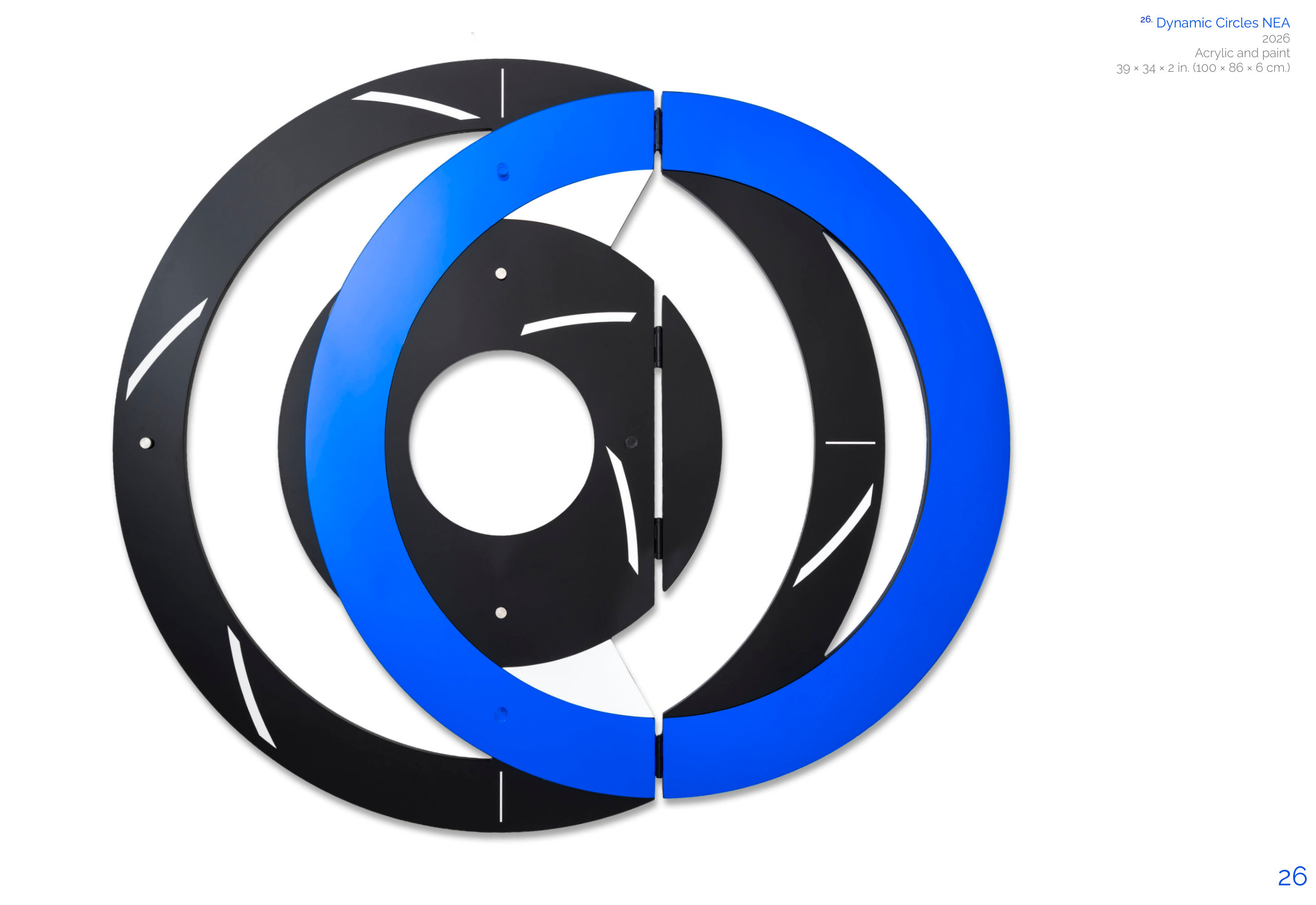
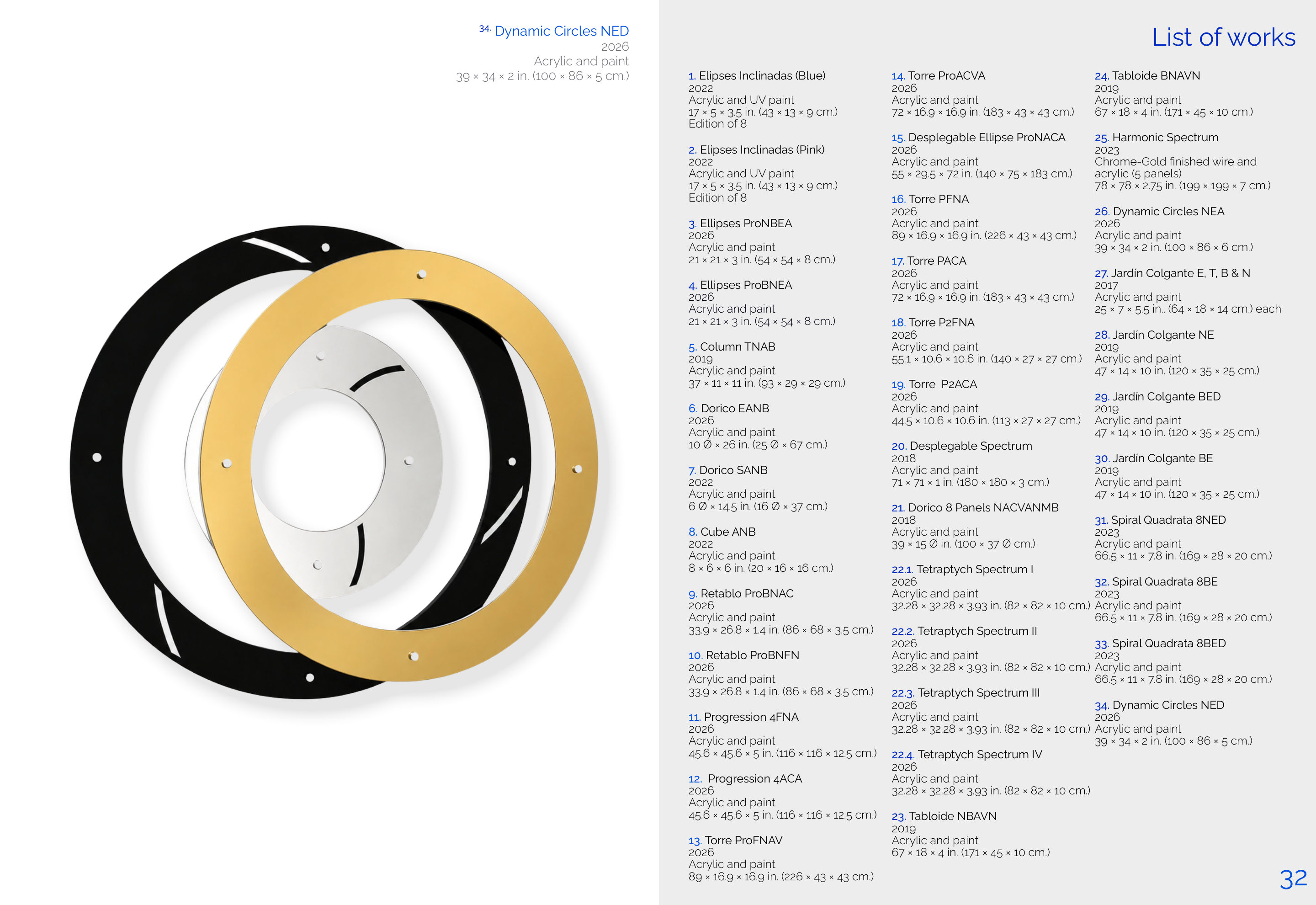
Ellipses ProNBEAWhile her constructive rigor remains constant, Ines Silva’s plastic vocabulary is in continual evolution. For several years now, she has shown a predilection for the ellipse, which, combined with proportions of the golden ratio, has become the generating principle of the artist’s reliefs, composed of superimposed, mobile planes (Ellipses ProNBEA). Transgressed by a few fine colored lines, Silva’s ellipses produce — depending on their orientation — effects of continuity or displacement, of interpenetration or rupture, highlighted by the contrasting use of white, blue, and black. The lines trace trajectories that animate the entire composition, passing from one plane to another and at times seeming to extend beyond the work itself. Despite this permanent mobility, the unity of the whole is never broken, so thoroughly does the underlying geometry establish a strong relationship between each element.
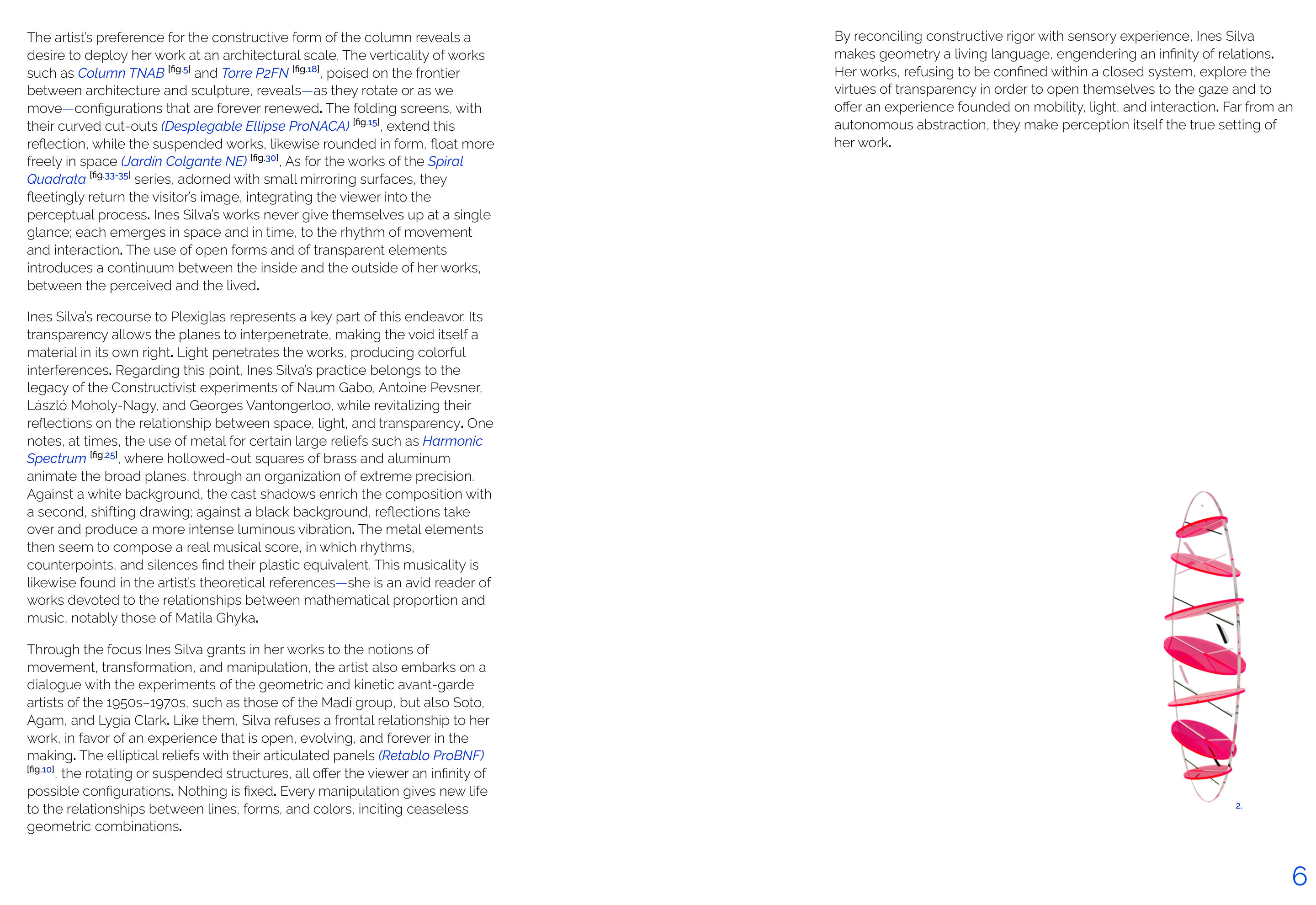
Progression 4FNATetraptych SpectrumSeveral of the artist’s series follow a principle of progression; conceived as proper visual crescendos, they present forms that gradually expand, accompanied by an intensification in the rhythmic deployment of the lines and colored planes (Progression 4FNA). The compositions alternate between vertical and horizontal readings, with interplays of obliques and counterpoint effects. Some works favor monochrome harmonies, with deep blues and intense pinks. But as a general rule, color — deliberately limited by Ines Silva to seven tones — intervenes minimally. Reduced most often to a mere thread, it discreetly guides the eye before mingling, in the course of the viewer’s movements or manipulations, with the other colored lines of the composition. The Tetraptych Spectrum series, however, produces intense chromatic vibrations that renew and intensify according to our movements.
Column TNABTorre P2FNDesplegable Ellipse ProNACAJardín Colgante NESpiral QuadrataThe artist’s preference for the constructive form of the column reveals a desire to deploy her work at an architectural scale. The verticality of works such as Column TNAB and Torre P2FN, poised on the frontier between architecture and sculpture, reveals — as they rotate or as we move — configurations that are forever renewed. The folding screens, with their curved cut-outs (Desplegable Ellipse ProNACA), extend this reflection, while the suspended works, likewise rounded in form, float more freely in space (Jardín Colgante NE). As for the works of the Spiral Quadrata series, adorned with small mirroring surfaces, they fleetingly return the visitor’s image, integrating the viewer into the perceptual process. Ines Silva’s works never give themselves up at a single glance; each emerges in space and in time, to the rhythm of movement and interaction. The use of open forms and of transparent elements introduces a continuum between the inside and the outside of her works, between the perceived and the lived.
Harmonic SpectrumInes Silva’s recourse to Plexiglas represents a key part of this endeavor. Its transparency allows the planes to interpenetrate, making the void itself a material in its own right. Light penetrates the works, producing colorful interferences. Regarding this point, Silva’s practice belongs to the legacy of the Constructivist experiments of Naum Gabo, Antoine Pevsner, László Moholy-Nagy, and Georges Vantongerloo, while revitalizing their reflections on the relationship between space, light, and transparency. One notes, at times, the use of metal for certain large reliefs such as Harmonic Spectrum, where small quadrilaterals of chrome- and gold-finished wire animate the broad planes, through an organization of extreme precision. Against the white ground, the cast shadows enrich the composition with a second, shifting drawing, while the reflections of the metal produce a luminous vibration that intensifies as we move. The metal elements then seem to compose a real musical score, in which rhythms, counterpoints, and silences find their plastic equivalent. This musicality is likewise found in the artist’s theoretical references — she is an avid reader of works devoted to the relationships between mathematical proportion and music, notably those of Matila Ghyka.
Retablo ProBNFThrough the focus Ines Silva grants in her works to the notions of movement, transformation, and manipulation, the artist also embarks on a dialogue with the experiments of the geometric and kinetic avant-garde artists of the 1950s–1970s, such as those of the Madí group, but also Soto, Agam, and Lygia Clark. Like them, Silva refuses a frontal relationship to her work, in favor of an experience that is open, evolving, and forever in the making. The elliptical reliefs with their articulated panels (Retablo ProBNF), the rotating or suspended structures, all offer the viewer an infinity of possible configurations. Nothing is fixed. Every manipulation gives new life to the relationships between lines, forms, and colors, inciting ceaseless geometric combinations.
By reconciling constructive rigor with sensory experience, Ines Silva makes geometry a living language, engendering an infinity of relations. Her works, refusing to be confined within a closed system, explore the virtues of transparency in order to open themselves to the gaze and to offer an experience founded on mobility, light, and interaction. Far from an autonomous abstraction, they make perception itself the true setting of her work.
Ines Silva’s Plexiglas works stand out for their airy, luminous, and profoundly musical character. Reliefs, columns, folding screens, and suspended structures create a universe in which transparency, movement, and color transform geometry into a sensory experience. Trained as an architect, Ines Silva constructs each of her works with great precision, drawing on mathematical schemes in which the golden ratio, the Fibonacci spiral, and Le Corbusier’s Modulor play a structuring role. Far from serving as a theoretical demonstration, these principles ensure a balance of form and establish a perceptible harmony between the work, its surrounding space, and the viewer’s body.
Conceived to inhabit a space with rhythm and dynamism, Ines Silva’s works never reveal themselves entirely at a single glance: they invite us to move around them and, at times, even to intervene, making perception itself their true setting. Open forms, superimposed and mobile planes, rotating or suspended structures, as well as an interplay of transparency with light, constantly renew the relationships between lines, forms, and colors.
Ines Silva thus makes geometry a living language, engendering an infinity of relations. Her work explores the virtues of transparency, movement, and interaction to offer an experience constructed in space and time — evolving and forever in the making.
Videos de las obras cinéticas.
Fotografías de la artista y su estudio.